Marketing just got handed the keys to a faster car. Most CMOs are still driving with a dashboard that updates once a quarter.
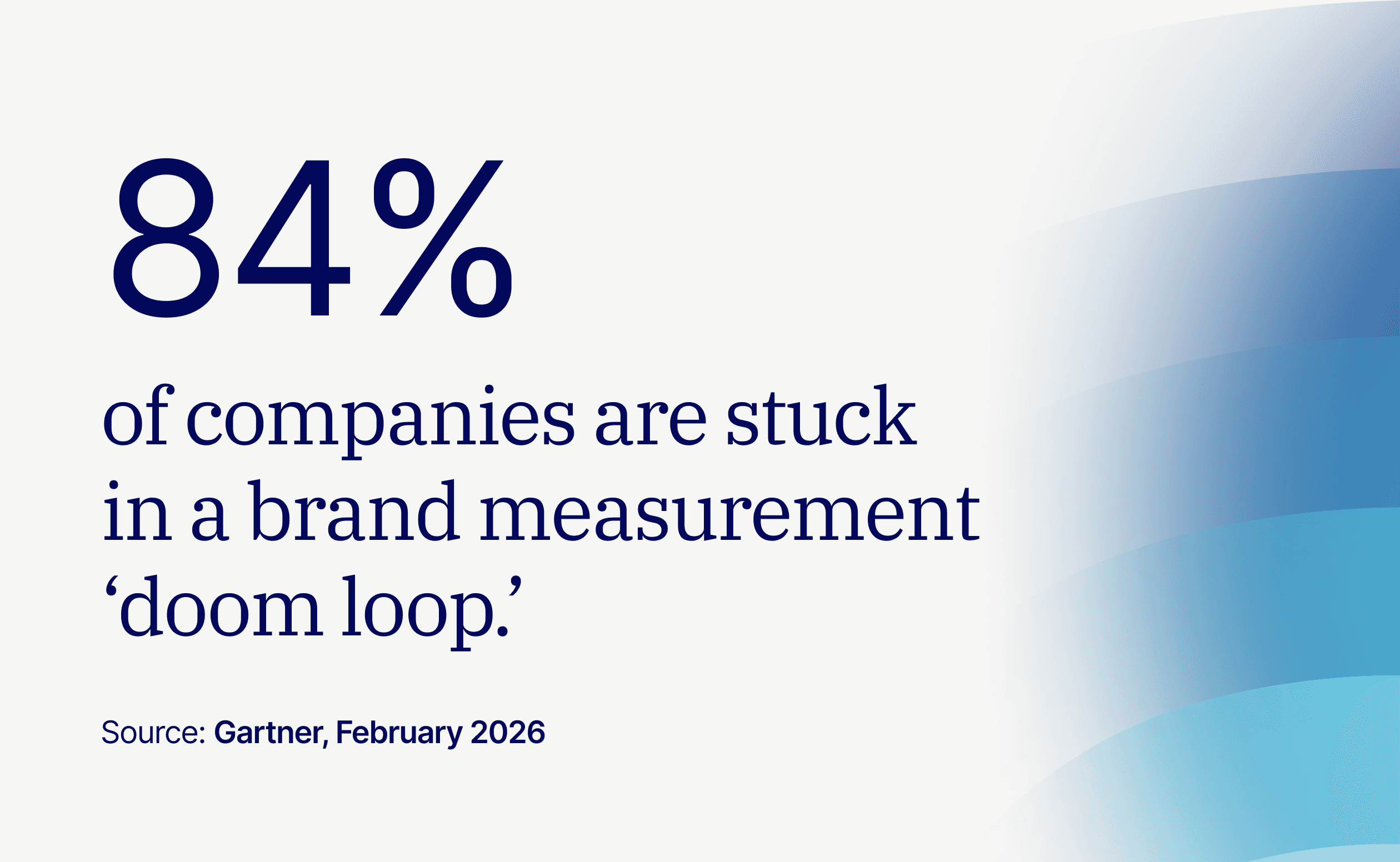
In February 2026, Gartner reported that 84% of companies remain stuck in a brand measurement "doom loop," where underfunded measurement leads to unclear impact, rising skepticism, and tighter budgets. Companies caught in this cycle are half as likely to exceed organizational growth targets.
This is not a tools problem. It is a visibility problem.
That pattern did not emerge overnight. Gartner's 2024 Senior Executive Views of CMO Leadership Survey showed marketing's scope expanding, with CEOs and CFOs expecting marketing's accountabilities to grow 1.6x over the next three to five years, even as alignment with the C-suite remained under strain.
Meanwhile, only 34% say they see eye to eye with their CMO on how marketing supports growth. Accountability is expanding. Measurement remains episodic. Competitive context is often invisible. This is the structural gap AI is about to widen.
The Dashboard Problem
Imagine being handed a faster, more powerful car. Better engine, more range, advanced systems under the bonnet. Except the dashboard only updates once every 90 days.
Speed? You'll find out in April.
Fuel level? We're running a survey.
The wall you're about to hit? The report is with the agency.
No one would drive that car. Yet that is precisely how most marketing organizations operate as they adopt AI.
Agentic systems act continuously. Customer sentiment shifts continuously. Competitors reposition continuously. But brand measurement still runs on episodic research, lagging indicators, and dashboards last updated around the board meeting.
A competitor can reposition, launch an AI-powered campaign, and shift category perception in a fortnight. If your brand intelligence arrives six weeks later, you are not measuring performance. You are conducting an autopsy. As Gartner's 2026 research makes clear, that performance gap translates directly into growth outcomes.
If you do not know where your brand stands relative to competitors this week, not this quarter, you are increasing speed without increasing control.
AI Will Reshape Discovery. Brand Will Determine Who Gets Chosen.
Gartner predicts GenAI shopping tools will generate less than 10% of e-commerce revenue in the near term. Consumer trust has not caught up. When it comes to actual purchasing decisions, brand credibility remains the decisive variable.
This challenges the assumption that AI will replace brand-building. It won't. AI will flood every channel with more content, more messages, more superficially competent marketing.
As AI intermediates discovery, brand position increasingly becomes an algorithmic input. In that environment, the brands that win are not the ones producing the most content. They are the ones with the clearest signal.
But you cannot strengthen what you cannot see. Underfunded, episodic measurement is precisely what keeps organizations trapped in that cycle. If you do not know where your brand stands relative to competitors this week, you are scaling execution without steering.
What Strategic CMOs Actually Do Differently
Gartner's research shows that CMOs significantly involved in the planning of corporate growth strategies are seven times more likely to exceed executive expectations. That is not marginal. It is existential.
Strategic involvement is not earned by adopting the latest AI tool and presenting a demo to the board. It is earned by consistently improving executive decision-making. Only 32% of executives say their CMO makes compelling business strategy recommendations based on market or customer data. The gap is not effort. It is the absence of decision-grade visibility.
Marketing leaders at SAP, Intel, AWS, and Roche are prioritizing continuous brand intelligence as part of their competitive strategy. The structural habits that separate them:
They connect brand metrics directly to business outcomes. Brand performance tied to pipeline, revenue, and competitive position.
They monitor competitive context continuously. Not the annual competitive audit that arrives beautifully formatted and already outdated. The kind of intelligence that lets you act before impact hits your pipeline, not after.
They build governance for AI-generated content before it scales. When agentic systems produce and distribute content at machine speed, reputational risk moves at machine speed too. A single poorly governed output can undo months of brand-building in hours.
They treat brand visibility as a strategic control system, not a reporting obligation. Visibility is not something you produce for board meetings. It is something you use to steer the business between them.
The 90-Day Infrastructure Reset
If this sounds familiar, the gap is structural. It does not begin with a technology purchase. It begins with an honest diagnostic.
Diagnose the visibility gap. Attempt to answer three questions with your leadership team: How did our brand perform versus our top three competitors last week? When did we last identify a competitive narrative shift before it hit pipeline? Is brand data connected to the same revenue conversations as demand gen? If those questions produce silence, the gap is real.
Quantify the strategic cost. Identify three to five decisions from the last two quarters that would have been materially better with stronger competitive context. Put an honest number on it. The cost of reacting eight weeks late to a competitor's repositioning. The cost of entering a pricing conversation without current brand perception data. When visibility is delayed, decision quality declines at the exact moment speed is increasing.
Build towards continuous intelligence. Establish baselines across awareness, trust, distinctiveness, and competitive position. Integrate brand intelligence into the dashboards your executives actually use. Make brand performance a standing agenda item, not a quarterly deep dive everyone endures but few act upon.
The goal is not more measurement. It is decision-ready intelligence.
The Bottom Line
AI is expanding marketing's power. But power without visibility creates exposure. Exposure compounds when measurement cannot demonstrate an impact on growth.
Only 34% of CEOs and CFOs are aligned with the CMO on marketing's role in growth. Accountability is expanding 1.6x. And 69% of executives say failure justifies removal. Those numbers describe a profession operating with very little margin for error.
The CMOs who reinforce the floor with continuous visibility, connected metrics, and real-time competitive intelligence will still be standing when the next wave of disruption hits. The ones who do not will struggle to defend their seat when disruption accelerates.
Marketing leaders at SAP, Intel, AWS, and Roche rely on BlueOcean's continuous intelligence to strengthen competitive visibility and defend growth with evidence, not slides.
If you cannot answer "How did we perform versus competitors last week?" it may be time to upgrade your visibility infrastructure.
→ Book a demo to see how real-time visibility changes the executive conversation.